Cranes and Lifting — What Actually Decides a Radius, and Why Capacity Falls Away From the Machine
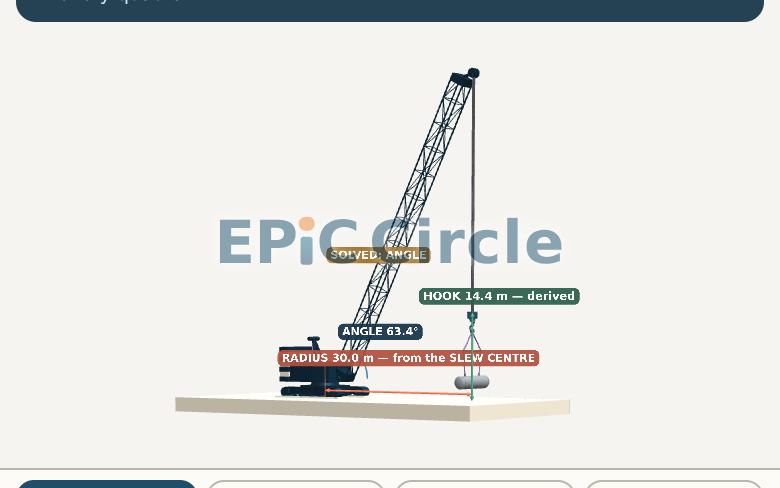
A 42 t exchanger bundle has to land on a plinth 30 m from the nearest hardstanding. The lift study says "250 t crawler, 54 m boom, 30 m radius, 8-fall, spreader beam." The superintendent reads it, looks at the drawing, and asks one question:
"At what boom angle?"
Nobody has written one down. Somebody says "about 70, it'll be fine". The answer is 63.4° , and it was never free to be anything else — the 54 m boom and the 30 m radius already decided it, the moment both numbers were written on the same line.
Then the…
🔒 Members only
The rest of this lesson is in the members' libraryThe full text, the 3D model, the worked example and the quiz.
Join to read it →A members' lesson from EPiC Circle
This one is part of the members' library — the full lesson, its 3D model, the worked example and the quiz open with membership. Dozens of lessons across every EPC discipline are free to read without an account.
See what's free →Educational teaching material — simplified and illustrative. Not for engineering
design use.
© EPiC Circle · provided by PipeAxis